

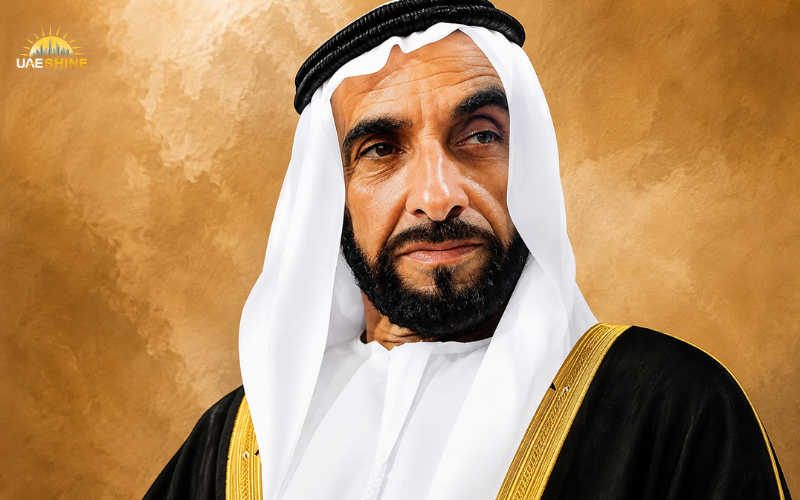
Sheikh Zayed bin Sultan Al Nahyan became the President of the United Arab Emirates in 1971, the founding father of the UAE, till his death in 2004. He was also the Ruler of Abu Dhabi since 1966, and is honored throughout the UAE as “Father of the Nation“.
His legacy is felt throughout the federation of seven emirates, over decades of social and infrastructure developments, and it continues to influence the UAE today through the family line.
Quick Facts
| Full Name | Zayed bin Sultan bin Zayed Al Nahyan |
| Born | c. 1918, Al Ain or Qasr al-Hosn, Abu Dhabi (exact date and birthplace disputed by historians) |
| Died | 2 November 2004, Abu Dhabi, aged approximately 86 |
| Nationality | Emirati |
| Known For | Founding Father of the UAE; first President of the UAE (1971-2004) |
| Ruler of Abu Dhabi | 6 August 1966 – 2 November 2004 |
| President of the UAE | 2 December 1971 – 2 November 2004 |
| Father | Sheikh Sultan bin Zayed Al Nahyan, Ruler of Abu Dhabi (1922-1926) |
| Mother | Sheikha Salama bint Butti Al Qubaisi |
| Wives | Widely reported to have married five to six times over his life |
| Children | More than 30 sons and daughters, including Sheikh Khalifa and Sheikh Mohamed bin Zayed |
| Successor | Sheikh Khalifa bin Zayed Al Nahyan (eldest son) |
Early Life and Family Background
Birth and Parents
Sheikh Zayed was born in 1918. No one agrees on the specific date and place; some refer to Al Ain, whilst others refer to Qasr al-Hosn in Abu Dhabi. He was the youngest of four children, being the son of Sheikh Sultan bin Zayed Al Nahyan, who ruled Abu Dhabi from 1922to 926, and Sheikha Salama bint Butti Al Qubaisi.
He was the father of Sheikh Shakhbut bin Sultan Al Nahyan, who is famous as the Ruler of Abu Dhabi from 1928 to 1960.
Bedouin Upbringing and Early Role
Since childhood, by growing up in a traditional Bedouin way, Sheikh Zayed became fascinated with falconry, tribal life in the desert, t nd the process of sorting out such tribal conflicts. In 1946, his brother Shakhbut appointed him to represent him in Al Ain and the Eastern Region, and he served there for 20 years.
At this time,e he established the first official schools in the region in 19,56 the Al Muwaiji school,o,ol and in 1959, Al Nahyaneia school.
Before becoming the ruler, what was Sheikh Zayed’s profession? For almost 20 years, he ruled the Eastern Region of Abu Dhabi for his brother, while also achieving first-hand experience in administration.
In addition, Sheikh Zayed, in his tenure in Al Ain, was responsible for the launch of early irrigation and agriculture projects in the region, which were inspired by the Oasis farming heritage as an answer to the increasing population.
Ruler of Abu Dhabi (1966-2004)
Becoming Ruler
On 6 August 1966, Shakhbut died, and her brother Sheikh Zayed succeeded him as Ruler of Abu Dhabi.
The change coincided with many years of frustration among Abu Dhabi’s elite with Shakhbut’s lack of desire to invest the city’s steadily increasing oil money into development. The replacement of rulers by the British placed in the Gulf at that time is generally characterised as bloodless.
Modernizing Abu Dhabi
Through his rulings, Sheikh Zayed directed the oil money towards developing infrastructure and public housing, as well as health services and education in the emirate. The Abu Dhabi towns gradually became lively small towns within a few years of the new state of modernization.
Within his first decade as ruler, new roads, ports, and an expanding electricity and water network were built, creating the base for the city, later connected with the emirate.
Oil Wealth and Development
In 1958, the discovery of oil in Abu Dhabi sparked oil exploration, which would lead to its accession to OPEC by 1967 under the leadership of Sheikh Zayed. He granted permission to form the first national oil company in Abu Dhabi in 1971, which was named the Abu Dhabi National Oil Company (ADNOC).
Was the wealth of oil Sheikh Zayed’s only source of funds? No. He also championed a forward-looking approach to diversification, being the first ruler to enter into real estate, aviation, and financial services – although oil was the most important sector for Abu Dhabi’s development during his reign.
Timeline of Rule
| Year | Milestone |
| 1946 | Appointed representative of Sheikh Shakhbut in Al Ain and the Eastern Region |
| 1958 | Oil discovered in Abu Dhabi, reshaping the emirate’s economic future |
| 1966 | Became Ruler of Abu Dhabi on 6 August, succeeding his brother Shakhbut |
| 1967 | Abu Dhabi joins OPEC under its leadership |
| 1968 | Begins federation talks with Dubai’s Sheikh Rashid bin Saeed Al Maktoum |
| 1970 | Abu Dhabi joins OAPEC |
| 1971 | Authorizes the creation of the Abu Dhabi National Oil Company (ADNOC) |
| 1971 | The UAE was formally established on 2 December; becomes the first President |
| 1976 | Establishes the Abu Dhabi Charity Organization |
| 2004 | Passes away on 2 November after nearly 33 years as President |
Founding the United Arab Emirates
Path to Federation
In the late 1960‘s, the UK government declared its intention to withdraw from the Gulf region, which ended the British protection of the Trucial States over decades.
In 1968, Sheikh Zayed started discussions with Dubai’s ruler, Sheikh Rashid bin Saeed Al Maktoum,m to establish a basis for the seven emirates to join into a federation.
First President of the UAE (1971)
On 2 December 1971, the six emirates formed the United Arab Emirates, and shortly af,t e,r in 197,2 Ras Al Khaimah joined to create the country. Sheikh Zayed was selected as the UAE’s first President, a role he held for almost 33 years until his death.
When asked about the naming of Sheikh Zayed as “Father of the Nation”, why? He is given the credit as the main orchestrator of the UAE’s federation and a facilitator for a common understanding between leaders of the emirates for a peaceful unification.
Building the Federal State
As President, Sheikh Zayed introduced a common national currency and integrated the emirates’ separate defense forces into a unified military. He also initiated federally funded development projects that saw the expansion of Abu Dhabi’s oil-propelled growth into the other emirates.
Abu Dhabi’s relative oil wealth meant Sheikh Zayed personally funded a large share of federal spending in the union’s early years, a factor that helped cement Abu Dhabi’s leading role within the UAE.
Government Roles at a Glance
| Position | Held |
| Representative in Al Ain / Eastern Region | 1946 – 1966 |
| Ruler of Abu Dhabi | 1966 – 2004 |
| Founding President of the UAE | 1971 – 2004 |
| Chairman, Abu Dhabi Charity Organization | 1976 – 2004 |
Legacy and Achievements
Environmental and Conservation Legacy
Sheikh Zayed is noted for his extensive projects of greening and reforestation in the desert areas of the UAE. He also championed the cause of the conservation of the Arabian oryx and the tradition of falconry, which he lives for to this day.
Over the years, millions of trees were planted in this emirate thanks to the afforestation campaign championed by Sheikh Zayed, and the environmental groups are rejoicing over this.
Education and Healthcare Reforms
During his reign, the UAE developed a large infrastructure of schools, hospitals, and public housing, which was not present before the 1960s. He had been working for the development of the Education system in Al Ain in the 1950s, which was then scaled up on the national level after federation.
Breadth of care also increased by a great deal – free public hospitals and clinics now reached areas that used to go to doctors or none.
International Recognition
In 2007, the Sheikh Zayed Grand Mosque in Abu Dhabi was named after him and is one of the largest mosques in the world. There are a number of widely shared economic analyses of the GCC that indicate that under his guidance, the UAE became the second largest economy in the GCC after Saudi Arabia.
Over the course of his life, Sheikh Zayed received numerous orders and medals from foreign countries – most related to his mediation efforts and diplomacy in the region.
Family: Wives and Children
| Relation | Name |
| First Wife | Hassa bint Mohammed bin Khalifa Al Nahyan |
| Third Wife | Sheikha Fatima bint Mubarak Al Ketbi (“Mother of the Nation”) |
| Notable Sons | Khalifa, Sultan, Mohamed, Hamdan, Hazza, Tahnoun, Mansour, Abdullah |
| Notable Daughters | Shamma, Al Yazia, and others across his marriages |
| Immediate Successor | Sheikh Khalifa bin Zayed Al Nahyan, the eldest son |
| Current UAE President | Sheikh Mohamed bin Zayed Al Nahyan, the third son of Sheikha Fatima |
Wives
The number of marriages Sheikh Zayed had during his lifetime varies from source to source, with a majority saying that he had between five and six marriages. In 1960, he married his third wife, Sheikha Fatima bint Mubarak Al Ketbi, and is widely known in the UAE as the ‘Mother of the Nation’.
How many were there for Sheikh Zayed? The number of wives is mentioned by most sources as being anywhere from five to six marriages, although others have recorded numbers as low as 3 and as high as 9. Like many ruling families in the Gulf, his marriages formed a number of strategic alliances with other UAE tribes.
Children
Sheikh Zayed is said to have fathered over 30 children, with the number of children being debated, with children for sons and daughters to daughters. His sons with Sheikha Fatima are: Mohamed, Hamdan, Hazza, Tahnoun, Mansour, nd Abdullah bin Zayed, who are all currently holding senior roles in the UAE government.
He was succeeded by his eldest son, Sheikh Khalifa bin Zayed Al Nahyan, as President of the UAE and Ruler of Abu Dhabi in 2004. How many children did Prince Zayed and Sheikh’s father have? It is estimated that he had between 30 and over 30 children; no official number has been released.
Death and Succession
On 2 November 2004, around the age of 86, Sheikh Zayed passed away in Abu Dhabi. He was interred in the middle of the courtyard of Sheikh Zayed Grand Mosque while it was still being constructed.
The next day, his eldest son, Sheikh Khalifa bin Zayed Al Nahyan, succeeded him as both UAE President and Ruler of Abu Dhabi. There was a smooth transition and a consensus that it was an indication of the succession Sheikh Zayed had established in the previous 20 years.
Conclusion
Under the leadership of His Excellency Sheikh Zayed bin Sultan Al Nahyan, Abu Dhabi has developed from a small Trucial State to become the anchor Emirate of a new Federal state. As the UAE President for almost 33 years, his tenure was characterised by infrastructure development, social reforms, and his detailed diplomacy in maintaining the unity of the seven emirates. He crafted a family line that remains the UAE’s leaders, as Khalifa and his son, Mohamed, became President later on.
Sheikh Zayed is still the most important name linked to the founding identity of the nation, and is ritually remembered each year and symbolised in the mosque named after him.
Must Explore: Ousha Al Suwaidi: Life, Poetry, Legacy, and Cultural Influence in UAE
Frequently Asked Questions
Who was Sheikh Zayed bin Sultan Al Nahyan?
He was the first President of the UAE and Ruler of Abu Dhabi, and is the Father of the Nation.
When did Sheikh Zayed become Ruler of Abu Dhabi?
He ascended to the throne of Abu Dhabi on 6th August 1966, following the death of his brother, Sheikh Shakhbut.
When was the UAE founded?
On 2 December 1971, the UAE was formally founded with Sheikh Zayed as the UAE’s first President.
How long was Sheikh Zayed the President of the UAE?
He served as President for almost 33 years, from 1971 until he died in 2004.
When did Sheikh Zayed die?
He died on 2 November 2004 in Abu Dhabi, at approximately 86 years old.
Who succeeded Sheikh Zayed as President?
He was followed by his elder son, Sheikh Khalifa bin Zayed Al Nahyan,n as President and Ruler of Abu Dhabi.
How many children did Sheikh Zayed have?
Here t, there are between 30 and more than 30 children, depending on the source of the data.
Who is Sheikh Mohamed bin Zayed to Sheikh Zayed?
This is her third son with His Highness the President of the UAE, Crown Prince Sheikh Mohamed bin Zayed Al Nahyan.
Why is the Sheikh Zayed Grand Mosque named after him?
It was constructed in his memory after his passing in 2004, and is one of the world’s largest mosques.
What was Sheikh Zayed’s role before he became ruler?
He served as his brother’s representative in Al Ain and the Eastern Region from 1946 to 1966.
Did Sheikh Zayed help found ADNOC?
Yes, he authorized the creation of the Abu Dhabi National Oil Company in 1971.
Is Sheikh Zayed related to Sheikh Mansour bin Zayed?
Yes, that is right. Sheikh Mansour, the owner of Manchester City FC, is his son with Sheikha Fatima bint Mubarak.
What is Sheikh Zayed best known for?
He is best known for his unification of the seven emirates into the United Arab Emirates (UAE) in 1971 and for the modernization of Abu Dhabi.