





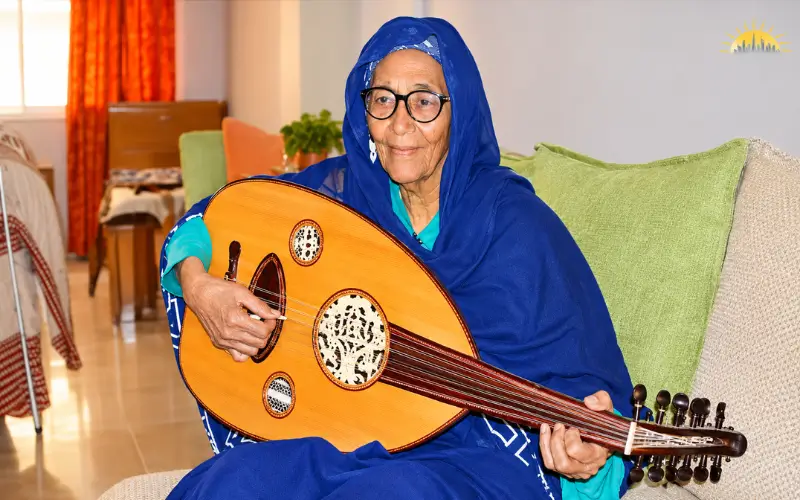
Asma Hamza wanted to become a singer when she was young, but problems with her voice took her career in a different direction. She found another way to stay close to music by learning the oud, eventually becoming one of Sudan’s pioneering female composers. Her melodies reached audiences through established singers, while her work with poets brought poetry and music together. Years of dedication earned her recognition in Sudan, particularly after her success in the 1997 Laylat AlQadr AlKubra competition. Google later introduced her story to a much wider audience through its 2023 Doodle.
Who Was Asma Hamza?
Asmaa Hamza was a musician and oud (a traditional instrument) player from Sudan, born in 1932. She was known for composing melodies for singers, collaborating with poets, and helping to nurture the talents of young musicians. Much of her work took place behind the scenes; while singers performed the melodies she created, she focused on crafting music that resonated with the words and meaning of each poem.
Her career also challenged the limited opportunities available to women in the Sudanese music scene during that era. In a 2017 interview with Sudanow magazine, she explained that while women had played musical instruments before her time, society was not readily prepared to recognize them as composers.
His achievements gradually earned him respect among musicians and poets. The acclaim he received at the 1997 ‘Laylat al-Qadr al-Kubra’ competition proved to be a significant milestone in his career, and later, on July 17, 2023, Google also paid tribute to him.
Quick Facts
| Detail | Information |
| Name | Asma Hamza |
| Birth year | 1932 |
| Birth country | Sudan |
| Nationality | Sudanese |
| Profession | Music composer and oud player |
| Main instrument | Oud |
| Musical background | Sudanese and Arabic music |
| Famous composition | Al Zaman Al Tayb |
| Other notable work | Azza and Azza |
| Major recognition | Laylat AlQadr AlKubra competition |
| Competition date | 17 July 1997 |
| Google Doodle | 17 July 2023 |
| Date of death | 21 May 2018 |
| Known for | Pioneering women’s participation in Sudanese music |
Early Life and Family Background
Asmaa Hamza was born in Sudan in 1932 and grew up in a family that cherished music and singing. Musicians frequently visited their home, providing her with ample opportunities throughout her childhood and youth to listen to a wide variety of voices and melodies.
She enjoyed listening to singers and often imagined that, one day, she too would perform. Her father recognized her interest in music and encouraged her to pursue it, even though certain vocal issues made it difficult for her to establish a career as a singer.
He also remembered several prominent Sudanese artists, including Ahmed Mustafa, Osman Hussein, Hassan Atiya, and Abdul Aziz Muhammad Dawood. Listening to their music during his early years familiarized him with the melodies and traditions that later influenced his own compositions.
Her Childhood Dream of Becoming a Singer
Singing was Hamza’s primary aspiration. She wished to perform before an audience, but issues with her vocal cords made it difficult for her to pursue this path. Nevertheless, her interest in music did not wane. Instead, she began whistling the melodies she heard, gradually developing the ability to memorize these tunes and reproduce them with exact precision.
Her father noticed this ability and decided to help her find another way to express herself. He borrowed an oud from a colleague in the army, giving her an instrument through which she could turn the melodies in her head into music.
This decision changed the course of his life. What began as an alternative to singing ultimately became the foundation of his career as a composer and oud player. Google’s official Doodle tribute also highlights the significant role his father played in encouraging the development of his musical talent.
How She Learned to Play the Oud
The oud became the instrument around which Hamza cultivated his musical skills. It features a rounded, wooden body, a short, fretless neck, and multiple strings. Musicians in the Middle East and North Africa have been playing it for centuries.
He did not begin with any formal music training. Instead, he would listen carefully to songs, memorize their melodies, and then attempt to play them on the instrument. His progress deeply impressed the person who had lent him the oud, and eventually, that individual allowed him to keep the instrument for good.
Regular practice helped her become more confident. Moving beyond playing familiar melodies, she began experimenting with her own original compositions, gradually cultivating the skills essential for musical composition.
Biographical accounts available on Google identify 1946 as a pivotal turning point in her development as an oud player. However, in a 2017 statement to ‘Sudanow,’ she described a musical environment where formal music institutions or schools did not exist. The available information does not fully clarify the nature of the “formal training” often attributed to her during that year.
Her Musical Education and Early Training
Hamza’s musical development relied heavily on listening, practicing, and interacting with other musicians. In an interview with *Sudanow*, he noted that formal music education was not readily available in Sudan during his early years.
He believed that talent and a profound understanding of music were of great importance. His own progress was achieved by focusing on melodies, practicing the *oud* (a musical instrument), and learning through engagement with other artists.
Google’s account also lists her among the first women in Sudan to learn to play the ‘oud’ (a musical instrument) through formal training. However, her own account presents a different picture regarding the educational opportunities available during that era.
Rather than attributing her skills to academic credentials that lack a solid basis, it would be more accurate to say that her proficiency developed through practical experience and an innate musical talent. These were the foundations upon which she built her artistic career.
Why She Composed Her First Melody in Secret
Hamza’s first musical composition came into being when a neighbor asked her to set some lyrics—written for a family event to a melody. Hamza agreed to help, but requested that her name not be disclosed as the composer.
At that time, society did not readily accept the involvement of girls in the creation of music. Hamza was concerned about how her family and others might react if they discovered that she was composing music.
In a 2017 interview with ‘Sudanow,’ she spoke from a personal perspective about the challenges women faced when entering this profession. While she already possessed the ability to compose melodies, openly claiming credit for her work was an entirely different matter.
Her father continued to support her interest in music, which enabled her to keep practicing. As she gained more experience, she grew increasingly confident and comfortable working with poets and singers under her own name.

Her Musical Style and African-Arab Influences
Sudanese musical traditions draw upon both African and Arab influences, and Hamza is immersed in this very blend. Her compositions reflect the musical environment she was familiar with, as well as her interest in various forms of Arab music.
During her interview, Hamza discussed pentatonic and heptatonic scales. A pentatonic scale utilizes five notes, while a heptatonic scale consists of seven; these offer musicians a range of different possibilities when crafting melodies.
She was well-versed in the various rhythms and musical structures found throughout Sudan. This knowledge enabled her to present poems from diverse perspectives, rather than relying on a single, fixed style.
Her work also reflected a deep appreciation for prominent Arab artists; among them, the Egyptian singer Umm Kulthum held a special place in her musical life.
Umm Kulthum’s Influence
Hamza was a great admirer of Umm Kulthum and fondly recalled her two meetings with the Egyptian singer. These encounters became cherished memories for her; she even kept a ticket from one of Umm Kulthum’s concerts as a memento.
She spoke of these experiences in a 2017 interview with ‘Sudanow ‘, a detail that highlights how closely she followed the work of prominent artists from the Arab world.
Umm Kulthum’s music was part of the broader Arab tradition that Hamza admired. At the same time, her own creative work remained deeply rooted in the culture of Sudanese music and the poetry she explored throughout her artistic career.
Her Work With Sudanese Poets and Singers
A significant part of Hamza’s professional work involved adapting written poetry into melodies that could be performed by singers. He collaborated with poets from diverse backgrounds and composed music based on their lyrics, thereby forging a deep connection between literature and the art of performance.
In her 2017 interview, she mentioned several poets whose work she had composed music for:
- Saif Eddin Al-Dassugi
- Saad Eddin Ibrahim
- Hassan Al-Zubair
- Abdul Wahab Hilawi
- Tahir Ibrahim
- Mohammed Ahmed Surkti
His melodies also reached audiences through prominent Sudanese artists, including Abdelkarim Al-Kabli, Mohamed Mirghani, and Imad Ahmed Tayeb. While discussing his musical work, he also mentioned other artists, such as Insaf Fathi, Shams, Jali Sheikh, and Osama Sheikh.
Thanks to these collaborations, the melodies he created reached a wider audience. While the singers brought these songs to the listeners, Hamza composed melodies that breathed life into the poets’ words.
How She Created Melodies for Poetry
Hamza would typically spend time reading a poem before composing music for it. She wanted to understand the meaning of the words and their flow before deciding what the melody should be like. Sometimes, she would hum the poem herself and then experiment with various musical styles on the ‘oud’ (a musical instrument). This process helped her grasp how the words could naturally become part of a song.
She did not always select a singer before completing a composition. Instead, she preferred to develop the melody first, allowing different artists the scope to offer their own interpretations of the finished work.
In an interview, she described musical inspiration as something that can arise naturally—much like the way ideas occur to a poet while writing.
Famous Compositions by Asma Hamza
Hamza composed music for individual songs as well as larger productions. Her catalogue included collaborations with well-known poets and singers, although not every melody she created received a public performance. Several compositions stand out in accounts of her career and offer a clearer picture of her work.
Ya Ouyouni
Ya Ouyouni, also written as Ya Oyouni, appears in published accounts as one of Hamza’s early compositions. The melody is associated with a poem by Egyptian poet Ali Mahmoud Taha, and some reports place its composition in 1956.
Her 2017 interview with Sudanow does not independently confirm that date, so it should be treated as a reported historical detail rather than a verified milestone.
The composition is associated with her early development as a composer, when she was moving beyond reproducing familiar songs and creating melodies for written poetry.
Al Zaman Al Tayb
Al Zaman Al Tayb is among the compositions most closely associated with Hamza’s career. She created its melody for a poem by Sudanese poet Saif Eddin Al-Dassugi.
Singer Sumaya Hassan performed the song in 1983, helping it reach a wider audience. The collaboration brought together Al-Dassugi’s poetry, Hamza’s music, and Hassan’s performance.
The song also shows why Hamza’s role as a composer mattered. Her melodies gave singers a musical foundation for presenting poetry to listeners, even when she was not the person performing on stage.
Azza and Azza
‘Azza and Azza’ was an operetta (musical drama) that Hamza considered one of the major achievements of her career.
In an interview with ‘Sudanow’, she spoke about this work, describing it as a significant turning point in her career as a composer. She also linked it to the years she spent working with the Sudanese Armed Forces—a period she recalled as being exceptionally productive and rewarding.
The operetta demonstrates her involvement in larger musical productions rather than work limited to individual songs. It remains one of the notable projects mentioned in accounts of her career.
Gamal Maadi
‘Jamal-e-Maazi’ (The Beauty of the Past) was another creation that Hamza mentioned in a live interview. This poem was written by the Sudanese poet Muhammad Bashir Atiq, who was also a close friend of his.
According to Hamza, Atiq told him that he had written this poem specifically about him. Hamza composed the melody for it, and subsequently, several singers performed the song.
The story behind this creation lends it a personal connection that goes far beyond the traditional relationship between a poet and a musician. It also reflects the deep friendships and creative partnerships that shaped the Sudanese artistic circles.
Aghla min nafsi
‘Aghla min nafsi‘ is another such creation, which Hamza confirmed in an interview with ‘Sudanow’. Hamza composed the melody, Abdul Wahab Halawi wrote the lyrics, and the Sudanese singer Abdul Karim Al-Kabli performed it.
Three artists were involved in this creative work, each with a distinct role: Halawi penned the lyrics, Hamza composed the music, and Al-Kabli presented the complete song to the audience.
It is a good example of how she contributed to Sudanese music without needing to perform every composition herself.
Her Work With the Sudanese Armed Forces
Hamza spent a significant portion of his professional life working with the music division of the Sudanese Armed Forces. He described these years as particularly productive, as it was during this period that he developed many of his melodies and creative works.
Through this role, he connected with musicians and singers who were engaged in structured musical productions. During this time, he was able to compose melodies, contribute to large-scale productions, and assist other artists in building their careers.
According to a 2023 report by *The Peninsula Qatar*, his association with the ‘Armed Forces’ School of Music began in 1982. This period is also linked to the work titled *Al Zaman Al Tayb*, presented by Sumaya Hassan in 1983.
Hamza also mentioned his efforts to support emerging artists, including Abida Sheikh. Thus, his work during those years encompassed both musical composition and the provision of support to other musicians.
The 1982 Music Establishment Milestone
According to a 2023 report by *The Peninsula Qatar*, his association with the ‘Armed Forces’ School of Music began in 1982. This period is also linked to the work titled *Al Zaman Al Tayb*, presented by Sumaya Hassan in 1983.
Hamza also mentioned his efforts to support emerging artists, including Abida Sheikh. Thus, his work during those years encompassed both musical composition and the provision of support to other musicians.
However, an interview from 2017 based on his own account does not provide independent verification of the exact date of his appointment. Therefore, this significant milestone from 1982 should be attributed to the reporting by ‘The Peninsula Qatar,’ rather than being considered a date verified by the individual himself.
The 1983 Al Zaman Al Tayb Performance
In 1983, Sumaya Hassan presented “Al Zaman Al Tayb,” a work that brought one of Hamza’s creations to a wider audience. The song featured a melody composed by Hamza for a poem written by Saif al-Din al-Dasuqi.
This release helped popularize the piece among Sudanese audiences and highlighted the connection between the three artists involved.
It also highlights an important part of Hamza’s career: her music often reached audiences through the voices of other performers. Her work as a composer gave singers material they could interpret and present in their own style.
Her Relationship With Bashir Abbas
Hamza also helped hone the musical talents of Bashir Abbas, who later became a renowned Sudanese musician and composer. In an interview with ‘Sudanow’, he mentioned that Bashir Abbas was a member of his family and that he had taught him how to play the ‘oud’ (a traditional musical instrument) during his childhood. He imparted his knowledge of the instrument to Bashir Abbas at a time when his own artistic career was still in its formative stages.
His statement reveals that their relationship went far beyond a mere professional connection. Familial ties provided him with the opportunity to pass on the skills he had acquired through years of practice and musical experience.
Later, Bashir Abbas carved out a distinct identity for himself within the world of Sudanese music. Hamza’s role in his training serves as a significant example of his influence on yet another generation of musicians.
Teaching and Supporting Young Musicians
Teaching was a natural extension of Hamza’s involvement in music. Having honed his own skills through listening and practice, he went on to share some of this knowledge with younger artists. His work with Bashir Abbas serves as a documented example of his pedagogical activities. He also mentioned Abida Sheikh when discussing artists whose artistic development he had supported.
These relationships demonstrate that his role was not limited merely to composing melodies for singers; he also helped other musicians refine their talents and integrate into the broader musical community of Sudan.
The Asma Hamza Salon in Halfaya
Hamza’s home in the Halfaya district of Khartoum became a regular meeting hub for singers, poets, and musicians. He likened these gatherings to the ‘artistic salons’ found in other parts of the Arab world.
Artists would come here to discuss their work, exchange ideas, and spend time with others who shared a mutual interest in music and poetry. Rather than functioning as a formal musical institution, this space evolved organically through personal connections.
Hamza recalled that some of these gatherings were also attended by prominent singers and politicians. Their presence helped establish this house as a key meeting point within his artistic circle.
This ‘salon’, a venue for literary and artistic gatherings, added another dimension to his contributions. Alongside the creation and teaching of music, he provided a space where individuals connected to Sudanese culture could meet and foster creative ties.
How Many Melodies Did Asma Hamza Compose?
In an interview with *Sudanow Magazine* in September 2017, Hamza stated that he had composed over 80 melodies. He further explained that many of the melodies he created were never presented to the public.
While this figure offers a glimpse into the volume of work produced throughout his career, it should not be mistaken for the number of officially released songs.
Understanding this distinction is important, as a musician may create compositions that never reach a recording studio or are never performed publicly. Hamza’s own remarks indicate that some of his work did not reach a wider audience.
He also expressed concern as to whether musicians of the new generation would continue to pay attention to his compositions. His statement regarding the more than 80 melodies remains the most authoritative and direct source of available information—more so than any complete, independently verified list.
Her Contribution to Women in Sudanese Music
Hamza entered the field of music composition at a time when opportunities for women to gain recognition and acceptance in this profession were extremely limited. She noted that while women had played musical instruments before her, the craft of composing melodies was largely considered the exclusive domain of men.
Her own experience reflected these very constraints. When she created her first composition, she asked a neighbor to keep her identity a secret, as she feared the reaction of those around her.
Over time, her work gained recognition from fellow musicians and audiences alike. She came to be known in Sudan as a female musician who played a pioneering role in the field, and she also garnered attention beyond her country’s borders.
She also mentioned her appearance on MBC television in Beirut, where she was presented as an Arab female musician who had been at the forefront of the field. This recognition positioned her contributions within a broader regional discourse concerning the inclusion of women in the realm of music.
Her career gave younger Sudanese women an example of someone who had built a place in composition despite the social expectations of her time.
Asma Hamza Achievement in the 1997 Competition
A major moment in Hamza’s public recognition came on 17 July 1997, when she was among the winners of Sudan’s Laylat AlQadr AlKubra music competition.
By that time, she had already spent several years composing melodies and collaborating with well-known singers and poets. This competition brought wider attention to the body of work she had developed over a long period. Later, Google described this achievement as a significant turning point in her career. It helped bring recognition to a woman working in a field that has traditionally been dominated by men.
The date also became closely associated with her story. Google selected 17 July for its 2023 tribute because it marked the anniversary of her achievement.
Why Google Honoured Asma Hamza in 2023
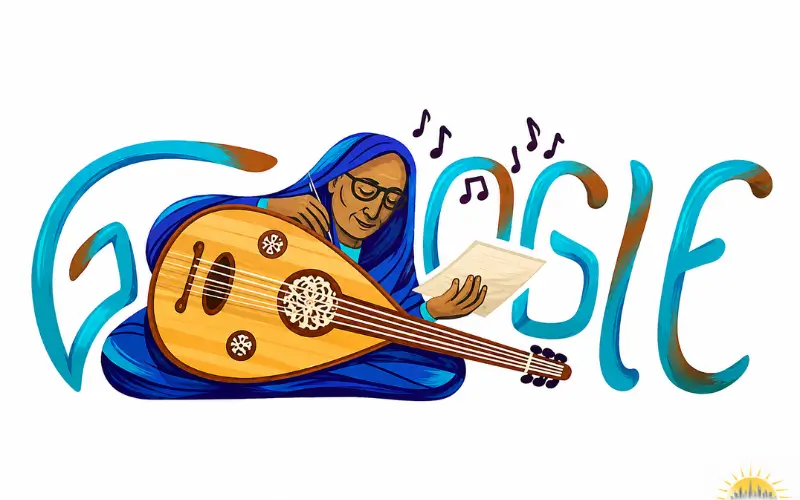
On July 17, 2023, Google released a special ‘Doodle’ in honor of Hamza. This date marked the 26th anniversary of his recognition at the ‘Laylat al-Qadr al-Kubra’ competition.
The Doodle depicted him with an ‘oud’ (a traditional musical instrument), drawing attention to his work as a Sudanese musician. Through this, his story was also shared with those who might not have been aware of his contributions to the field of music.
The official tribute highlighted several parts of her life:
- Her childhood interest in music and singing.
- Her father’s encouragement to learn the oud.
- Her early development through listening and practice.
- Her first composition, which she initially kept secret.
- Her work creating melodies for established singers.
- Her role in opening opportunities for women in Sudanese composition.
The Doodle brought renewed attention to his achievements and drew audiences toward Sudanese music. Readers can view the original tribute on Google’s official Doodles website.
Countries Where the Google Doodle Appeared
This 2023 tribute reached audiences across the Middle East and North Africa. According to a report by *The National*, Google featured this ‘Doodle’ in several countries, including the United Arab Emirates, Saudi Arabia, Egypt, Jordan, Iraq, and Oman.
It also appeared in Morocco, Algeria, and Libya, extending the reach of this tribute beyond Sudan to people throughout the entire region and introducing them to Hamza’s work.
For UAE readers, the Doodle provided an opportunity to learn about a Sudanese composer whose career reflected the shared musical and cultural influences of Africa and the Arab world.
Why Her Story Matters to UAE Readers
Although Hamza built her career in Sudan, her music forms part of a wider cultural tradition familiar to audiences across the Middle East. Sudanese poetry, Arabic musical influences, and African rhythms all contribute to the region’s diverse artistic history.
The UAE is home to people from different Arab and African communities, making stories about Sudanese musicians relevant to its wider cultural landscape. Her work also offers an example of how women pursued creative careers despite limited opportunities and social restrictions.
The Google Doodle appeared in the UAE on 17 July 2023, and regional publications such as The National and Khaleej Times covered her achievements.
Her story deserves attention from readers interested in Sudanese culture, Arabic music, and the history of female composers. It also highlights the contribution of artists whose work often remains behind the performances that audiences remember.
Her Final Years and Death
Hamza remained connected to her musical work and the people she had encountered throughout her career. In a 2017 interview, she spoke about her creative works, including compositions that had yet to be released, while also expressing concern that younger generations might overlook some of her contributions.
She also mentioned a desire to organize a major musical production featuring singers from across the Arab world, an idea that reflected her enduring interest in bringing diverse artists together through music.
She passed away on 21 May 2018, before Google honoured her with its Doodle in 2023. The tribute later brought renewed attention to her compositions and the contribution she had made to Sudanese music.
Published accounts do not consistently agree on her exact age at death. Her birth year of 1932 and death date of 21 May 2018 are more useful biographical details than repeating an age that varies between reports.
Asma Hamza’s Career Timeline
The following timeline brings together the main events associated with her life, musical development, and public recognition.
| Year or date | Important event |
| 1932 | Born in Sudan |
| Childhood | Developed an interest in music and dreamed of becoming a singer |
| Early musical years | Began learning the oud with encouragement from her father |
| 1946 | Google reports her among the first formally trained female oud players in Sudan |
| 1956 | Reported date associated with her early composition Ya Ouyouni |
| 1982 | Reported association with the Armed Forces’ School of Music |
| 1983 | Sumaya Hassan performed Al Zaman Al Tayb |
| 1997 | Received recognition in the Laylat AlQadr AlKubra competition |
| 2017 | Gave an extensive interview to Sudanow Magazine |
| 21 May 2018 | Passed away |
| 17 July 2023 | Google honoured her with a Doodle |
The entries for 1946, 1956, and 1982 are drawn from published accounts, and available sources do not provide full details regarding each of these significant milestones. Rather than being viewed as a complete record of formal education and professional appointments, they should be regarded merely as ‘stated dates.’
Her Lasting Musical Legacy
Hamza left a mark on Sudanese music through her compositions, her work with other artists, and the support she gave to younger musicians. Her career also showed that women could establish themselves as composers despite the restrictions they faced during her early years.
Her contribution can be seen in several parts of Sudanese musical life:
Musical composition: She said she had created more than 80 melodies, many of which were written for established Sudanese singers.
Work with poets: Her collaborations brought written poetry to audiences through music and performance.
Women’s participation: She gained recognition in a profession where women had limited opportunities to work openly as composers.
Teaching: Her work with Bashir Abbas and other younger artists helped pass musical knowledge to another generation.
Artistic gatherings: Her home in Halfaya provided a meeting place for people involved in music, poetry, and cultural life.
Regional recognition: Her 1997 competition achievement and Google’s 2023 tribute introduced her work to audiences beyond Sudan.
Their story also highlights the importance of composers in the musical history of a nation. While singers often take center stage in the public eye, the melodies behind their performances are the creations of individuals whose work deserves equal recognition.
Conclusion
Asma Hamza began with the dream of becoming a singer, but challenges with her voice led her to focus on vocal training. This decision opened a new path, allowing her to emerge as a composer whose melodies reached audiences through some of Sudan’s established performers.
She collaborated with poets, supported young musicians, and created a space where artists could gather and exchange ideas. Her recognition at the 1997 *Lailat al-Qadr al-Kubra* competition marked a pivotal stage in her career, while a 2023 Google Doodle brought her story to a broader regional and international audience.
Her role is an important part of the history of Sudanese music, especially for women who wish to build a career in the field of music composition.
Also Explore: Dr. Saniya Habboub Biography
Frequently Asked Questions
1. Who was Asma Hamza?
Asmaa Hamza was a musician and oud player from Sudan who composed melodies for renowned singers and was counted among the pioneering women in the field of Sudanese musical composition.
2. When was Asma Hamza born?
According to published biographical accounts and a tribute presented by Google, she was born in Sudan in 1932.
3. What instrument did Asma Hamza play?
She played the oud, a traditional string instrument used widely in Arabic and Middle Eastern music.
4. What was Asma Hamza’s first composition?
Her earliest composition was a melody she secretly created for a neighbour’s family celebration. Ya Ouyouni is also identified in published accounts as one of her early works.
5. What are Asma Hamza’s famous compositions?
Her notable compositions include Ya Ouyouni, Al Zaman Al Tayb, Azza and Azza, Gamal Maadi and Aghla min nafsi.
6. How many melodies did Asma Hamza compose?
She said in her 2017 Sudanow interview that she had composed more than 80 melodies, including some that had never been performed publicly.
7. Why did Google honour Asma Hamza?
Google honoured her on 17 July 2023 to mark the anniversary of her recognition in Sudan’s Laylat AlQadr AlKubra music competition in 1997.
8. When did Asma Hamza die?
He passed away on May 21, 2018. News of his death was reported in regional and international publications.